
FCAP Technologies Pvt. Ltd. · CIN: U72900MH2018PTC456805 · Registered office: Awfis Building, 10th Floor, R City Offices, Lal Bahadur Shastri Rd, Ghatkopar West, Mumbai, Maharashtra 400086
Grievance Officer: Nitin Nair · contact@bharatnxt.in · +91 98730 33604
Finance & Taxation
Understand B2B vs B2C in GST, B2CS meaning, B2CL limits, invoice requirements, ITC eligibility and GSTR-1 reporting with examples.
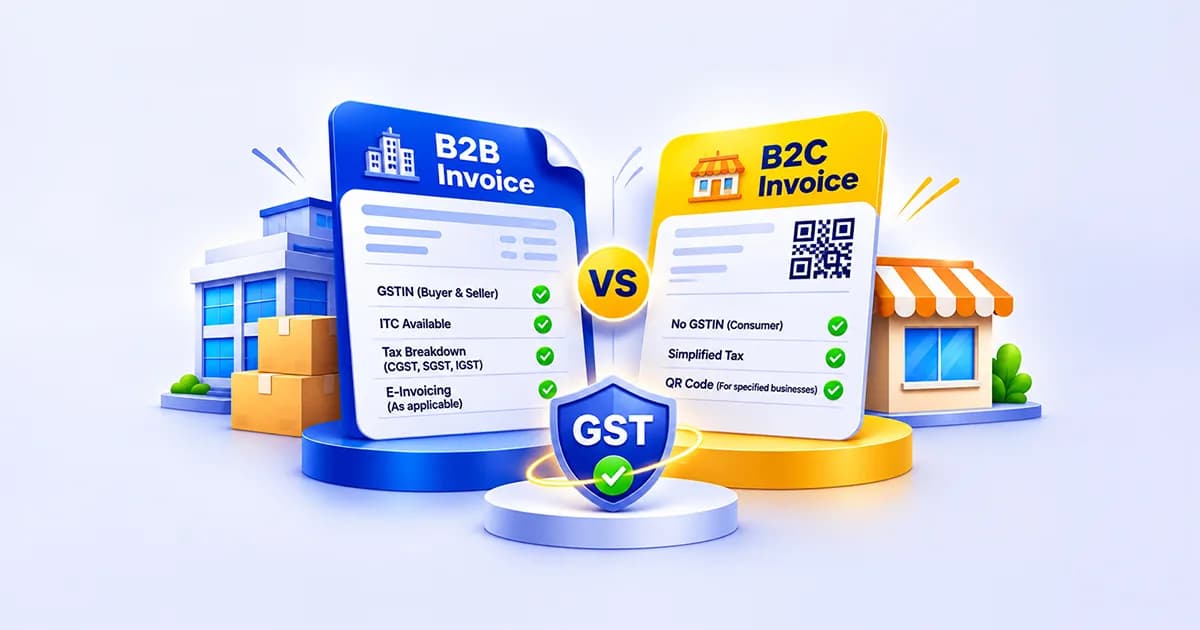
Every business transaction involves a buyer and a seller. However, under India's Goods and Services Tax (GST) system, the classification of a transaction depends on whether the buyer is a registered business or an unregistered consumer.
This brings us to two important GST classifications: B2B and B2C.
B2B stands for Business to Business, while B2C stands for Business to Consumer. These classifications determine how businesses issue invoices, report sales in GST returns and manage compliance requirements.
For businesses registered under GST, understanding this distinction is essential. Incorrect classification can lead to errors in GSTR-1 filing, inaccurate tax reporting and difficulties in reconciling transactions.
Additionally, GST divides B2C transactions into two categories: B2C Small (B2CS) and B2C Large (B2CL). Each category has different reporting requirements, particularly for inter-state transactions.
In this guide, we'll explain the difference between B2B and B2C in GST, the meaning of B2CS and B2CL, their invoice requirements, applicable limits and how to report these transactions.
B2B stands for Business to Business. It refers to transactions in which one GST-registered business supplies goods or services to another GST-registered business.
In simple terms, a transaction generally falls under B2B when both the seller and the buyer hold valid GST registrations.
For example, suppose a manufacturer in Maharashtra sells goods worth ₹2,00,000 to a GST-registered wholesaler in Gujarat. Since both businesses have GST registrations, the transaction qualifies as B2B.
Since both businesses are registered under GST, the transaction is classified as B2B.
Depending on the place of supply and the location of the supplier, the transaction may attract either IGST or CGST and SGST.
A B2B tax invoice generally includes:
The invoice must contain the prescribed particulars under Rule 46 of the CGST Rules.
cbic-gst.gov.in
B2C stands for Business to Consumer. It refers to transactions where a GST-registered business sells goods or services to an unregistered customer.
These customers may include individual buyers, households or consumers who purchase products for personal use.
Example:
A registered electronics shop in Mumbai sells a mobile phone worth ₹30,000 to an individual who does not have a GST registration.
Since the buyer is unregistered, this is classified as a B2C transaction.
Unlike B2B transactions, B2C transactions are further divided into two categories based on the nature and value of the supply:
Understanding these categories is important because they determine how sales must be reported in GSTR-1.
B2CS stands for Business to Consumer Small. It is a category used in GST return reporting for eligible sales made by registered businesses to unregistered customers.
In simple words, B2CS covers B2C transactions that are reported as consolidated details rather than individually, invoice by invoice, in GSTR-1.
Under the current reporting rules, B2CS generally includes:
These transactions are reported in Table 7 – B2C Others of GSTR-1, with the applicable details consolidated state-wise and tax-rate-wise.
The ₹1 lakh threshold applies to inter-state B2C invoice reporting. It does not apply to intra-state B2C transactions.
Let's understand this with a few examples.
Example 1: Intra-state sale
A registered clothing store in Delhi sells clothes worth ₹15,000 to an unregistered customer in Delhi.
Since the transaction is intra-state, it falls under B2CS regardless of the invoice value.
Example 2: Inter-state sale below ₹1 lakh
A registered business in Maharashtra sells goods worth ₹80,000 to an unregistered customer in Gujarat.
Since the inter-state invoice value is ₹1 lakh or less, it is classified as B2CS.
Example 3: Inter-state sale of exactly ₹1 lakh
A registered seller in Karnataka sells goods worth exactly ₹1,00,000 to an unregistered customer in Tamil Nadu.
This transaction also falls under B2CS because the invoice value does not exceed ₹1 lakh.
B2CS transactions are reported in Table 7 (B2C Others) of GSTR-1.
Instead of entering every eligible invoice separately, businesses report consolidated transaction details.
The information generally includes:
Businesses should maintain proper invoice-level records even when consolidated reporting is permitted.
The GST Network's Returns Offline Tool identifies B2CS as B2C Small and provides separate reporting worksheets for B2CS and B2CL transactions.
tutorial.gst.gov.in+1
B2CL stands for Business to Consumer Large. It refers to qualifying inter-state B2C transactions where the invoice value exceeds ₹1 lakh.
Unlike B2CS transactions, businesses must report these supplies invoice-wise in Table 5 of GSTR-1.
Earlier, the reporting threshold was ₹2.5 lakh. However, the government reduced it to ₹1 lakh with effect from 1 August 2024.
Example 1: Inter-state sale above ₹1 lakh
A registered furniture manufacturer in Maharashtra sells furniture worth ₹1,50,000 to an unregistered customer in Goa.
Since the invoice value exceeds ₹1 lakh, the transaction is classified as B2CL.
Example 2: Inter-state sale of ₹2 lakh
A registered electronics seller in Gujarat sells a television worth ₹2,00,000 to an unregistered customer in Rajasthan.
This is also a B2CL transaction because the invoice value exceeds ₹1 lakh.
B2CL transactions are reported invoice-wise in Table 5 of GSTR-1.
The supplier must furnish prescribed invoice details, including:
Unlike B2CS, B2CL transactions require invoice-level reporting.
Important: The ₹1 lakh threshold determines the reporting classification. It does not change the GST rate applicable to the supply.
Here's a quick comparison of all four categories.
| Parameter | B2B | B2C | B2CS | B2CL |
|---|---|---|---|---|
| Full form | Business to Business | Business to Consumer | Business to Consumer Small | Business to Consumer Large |
| Buyer | GST-registered business | Unregistered customer | Unregistered customer | Unregistered customer |
| Transaction type | Intra-state or inter-state | Intra-state or inter-state | Intra-state or qualifying inter-state | Inter-state |
| Invoice value limit | No B2CL-style threshold | Depends on B2CS/B2CL classification | Any value intra-state; up to ₹1 lakh inter-state | Above ₹1 lakh inter-state |
| GSTR-1 reporting | Invoice-wise | Classified under B2CS or B2CL | Consolidated | Invoice-wise |
| ITC eligibility | Buyer may claim, subject to conditions | Not available to unregistered buyer | Not available to unregistered buyer | Not available to unregistered buyer |
Remember: B2C is the broader category of transactions with unregistered customers. B2CS and B2CL are the two reporting classifications used for these transactions.
One of the most important differences between B2CS and B2CL is the invoice value threshold applicable to inter-state transactions.
Earlier, inter-state B2C invoices exceeding ₹2.5 lakh had to be reported invoice-wise under B2CL. This threshold was revised to ₹1 lakh from 1 August 2024.
Here's how the current classification works:
| Type of transaction | Invoice value | Classification |
|---|---|---|
| Intra-state B2C sale | ₹20,000 | B2CS |
| Intra-state B2C sale | ₹2,00,000 | B2CS |
| Inter-state B2C sale | ₹50,000 | B2CS |
| Inter-state B2C sale | ₹1,00,000 | B2CS |
| Inter-state B2C sale | ₹1,00,001 | B2CL |
| Inter-state B2C sale | ₹5,00,000 | B2CL |
Note: These classifications refer to eligible outward supplies made to unregistered persons under the regular GST reporting framework. Special categories of supplies may have separate reporting requirements.
The GST Council recommended reducing the threshold for invoice-wise reporting of inter-state B2C supplies to improve the availability of transaction-level information for tax administration and settlement between states.
The change was subsequently implemented through Notification No. 12/2024-Central Tax, effective 1 August 2024.
pib.gov.in+1
Businesses should therefore use the revised ₹1 lakh threshold when classifying their eligible inter-state B2C invoices.
Issuing the correct GST invoice is an important part of business compliance. However, the information required on an invoice can differ depending on whether the customer is registered or unregistered.
For B2B transactions, the invoice should include:
The buyer's GSTIN is particularly important because the recipient may use the invoice details to establish eligibility for ITC, subject to the applicable conditions.
For B2C transactions, the buyer is generally not registered under GST. Therefore, the invoice does not contain the recipient's GSTIN.
However, the supplier must still issue the appropriate document and maintain the prescribed details.
A B2C invoice generally includes:
Is the customer's address required on a B2C invoice?
Under Rule 46(e) of the CGST Rules, the name and address of an unregistered recipient, along with the delivery address and state details, must be captured where the taxable supply value is ₹50,000 or more.
The relevant invoice requirements should be followed based on the nature and value of the transaction.
cbic-gst.gov.in
GSTR-1 is the GST return in which registered taxpayers report details of their outward supplies of goods and services.
The reporting tables differ depending on the type of transaction.
Here's a simplified breakdown:
| Transaction category | GSTR-1 table | Reporting method |
|---|---|---|
| B2B supplies | Table 4 | Invoice-wise |
| B2CL supplies | Table 5 | Invoice-wise |
| B2CS supplies | Table 7 | Consolidated |
Once all relevant sections are completed, review the GSTR-1 summary and proceed with filing using the applicable authentication method.
Important: GSTR-1 is a statement of outward supplies. Businesses should reconcile the information with their books of accounts and other GST records before submission.
The GST Network's official offline utility also provides separate data-entry sections for B2B, B2CS and B2CL reporting.
tutorial.gst.gov.in
E-invoicing is an important part of GST compliance for businesses that fall under the notified turnover criteria.
Under the e-invoicing system, eligible businesses must report specified invoices to an Invoice Registration Portal (IRP) to obtain an Invoice Reference Number (IRN) and a digitally signed QR code.
E-invoicing is applicable to registered businesses whose aggregate annual turnover has exceeded ₹5 crore in any financial year from 2017-18 onwards, subject to notified exclusions.
The requirement has been implemented in phases and became applicable to businesses exceeding the ₹5 crore threshold from 1 August 2023.
Goods and Services Tax Council+1
Yes. Businesses covered under the e-invoicing mandate must generate e-invoices for applicable B2B supplies, including notified export transactions.
This generally involves:
No. The standard e-invoicing requirement does not apply to ordinary B2C invoices in the same way it applies to covered B2B and export invoices.
However, certain businesses may have to comply with the separate Dynamic QR Code requirement for B2C invoices.
This distinction is important: e-invoicing and Dynamic QR Code requirements are separate GST compliance provisions.
QR codes are used to make invoice verification and digital payments easier.
Under GST, the Dynamic QR Code requirement applies to specified registered persons whose aggregate turnover exceeds ₹500 crore in a financial year, for applicable B2C invoices.
This requirement was introduced through Notification No. 14/2020-Central Tax, subject to specified exclusions.
IndiaCode+1
The QR code should contain prescribed details, including:
The purpose is to allow customers to scan the code and make digital payments while ensuring that the payment can be linked to the relevant invoice.
No. The Dynamic QR Code requirement is not applicable to every GST-registered business.
It applies to the specified class of businesses based on aggregate turnover, subject to the exemptions and conditions under the relevant notifications.
Small businesses should not assume that the ₹1 lakh B2CL reporting threshold makes Dynamic QR Codes mandatory for their invoices. These are two different requirements.
Incorrect invoice classification and reporting can create avoidable compliance problems.
Here are some common mistakes businesses should watch out for:
1. Using the wrong B2CS and B2CL threshold
Some businesses continue to use the earlier ₹2.5 lakh threshold for inter-state B2C invoices.
The applicable threshold for B2CL invoice-wise reporting is now above ₹1 lakh.
2. Treating every B2C transaction as B2CS
B2C transactions need to be classified correctly. Inter-state B2C invoices exceeding ₹1 lakh fall under B2CL and require invoice-wise reporting.
3. Reporting B2B transactions as B2C
Always verify the buyer's GSTIN and registration status before classifying the transaction.
4. Entering incorrect place-of-supply details
The place of supply plays an important role in determining whether a transaction is intra-state or inter-state.
Incorrect details can lead to the wrong tax being reported.
5. Missing invoice details
Incorrect invoice numbers, dates, GSTINs, taxable values or tax amounts can create reconciliation issues.
6. Incorrectly reporting consolidated B2CS sales
Businesses must report B2CS details using the appropriate state-wise and tax-rate-wise classification rather than combining unrelated transactions.
7. Ignoring e-invoicing and QR Code requirements
Businesses that fall under the applicable e-invoicing or Dynamic QR Code provisions must follow the relevant requirements and exemptions.
Ultimately, businesses can avoid many common GST errors by maintaining accurate sales records and reviewing their returns before filing. Regular checks also help identify discrepancies early and make the compliance process smoother.
B2CS stands for Business to Consumer Small. It is a GST reporting category used for eligible B2C transactions that are reported in consolidated form in Table 7 of GSTR-1.
B2CS includes all eligible intra-state B2C supplies and inter-state B2C invoices valued at ₹1 lakh or less. B2CL includes inter-state B2C invoices exceeding ₹1 lakh. B2CS is reported in consolidated form, whereas B2CL is reported invoice-wise.
There is no invoice value limit for intra-state B2CS transactions. For inter-state B2C transactions, invoices valued at ₹1 lakh or less are classified as B2CS.
An inter-state B2C invoice with a value exceeding ₹1 lakh is classified as B2CL and must be reported invoice-wise in GSTR-1.
B2CS transactions are reported in Table 7, also known as B2C Others, of GSTR-1.
B2CL transactions are reported invoice-wise in Table 5 of GSTR-1.
An unregistered B2C customer cannot claim Input Tax Credit because they are not registered under GST. A GST-registered business purchasing goods or services for eligible business purposes may be able to claim ITC, subject to the conditions prescribed under GST law.
Understanding the difference between B2B and B2C transactions is essential for businesses registered under GST. From issuing the right invoices to reporting sales correctly in GSTR-1, every transaction must be classified accurately.
While B2B transactions involve supplies between registered businesses, B2C transactions involve sales to unregistered customers. Further, understanding the difference between B2CS and B2CL helps businesses follow the correct reporting process.
Keeping up with GST notifications, maintaining accurate invoices and reviewing returns regularly can help businesses manage their GST compliance more efficiently.
Explore more guides, or see which BharatNXT product fits the gap you are dealing with.
No. Since the customer is unregistered, their GSTIN is not required. However, the supplier must include the prescribed invoice details, including recipient information where required under Rule 46.
The standard e-invoicing mandate applies to specified B2B and export transactions for eligible businesses. Ordinary B2C invoices are not covered by the same requirement, although separate Dynamic QR Code provisions may apply to certain businesses.
The threshold was revised with effect from 1 August 2024 through Notification No. 12/2024-Central Tax.
No. Eligible B2CS transactions are generally reported in consolidated form in Table 7 of GSTR-1, with the relevant state-wise and tax-rate-wise details.
Incorrect classification can result in inaccurate GSTR-1 reporting and reconciliation issues. Businesses should review the relevant invoice details and make corrections through the applicable GST return amendment process.